
GROCERY WORKERS FILE FEDERAL LAWSUIT AGAINST UFCW INTERNATIONAL
UFCW Member Voting Power Varies Widely From Local to Local, Suppressing Rank & File Members’ Calls For Reform
“Rank-and-file members are waking their sleeping union giants.”
The complaint on behalf of Kyong Berry of Washington state and Iris Scott of Massachusetts was filed with the D.C. District Court on Friday morning. The suit claims that UFCW doles out unequal rights and powers to different groups of union members (locals), in violation of the Labor Management Reporting and Disclosure Act, which states that every labor union member shall have equal rights and privileges.
“UFCW International’s system is rigged to keep certain rank-and-file members’ voices quiet, just as CEOs and corporations rig the workplace to keep workers’ voices quiet. ”
Rank-and-file members criticize UFCW International leadership for failing to capitalize on high worker interest in unions, discouraging members to use strikes against employers, and much more. At last year’s UFCW convention in Las Vegas, rank-and-file members were stopped from passing a package of reform amendments including: One Member, One Vote; First Day Strike Pay; Salary Caps for Top Officers; and Coordinated Bargaining.
Plaintiff and first-time UFCW delegate Iris Scott recorded her thoughts during last year’s convention.
“Voting rights for union members should not vary by a 300 to 1 ratio depending on the size of the local union you belong to. My union, UFCW 3000, is the largest with more than 50,000 members but we have fewer votes per member than other unions. This isn’t an accident, it’s the way UFCW International has rigged the system to keep certain people in power indefinitely and it’s illegal.”
Equal representation has transformed the Teamsters, SAG-AFTRA, and UAW into fearless, powerful forces, winning big raises for workers, and organizing more members, through strikes and coordinated bargaining. The Teamsters, UAW, ILWU, SAG-AFTRA and other unions have a one member one vote system that enables union members to vote directly for their top leaders and policies.
Rank-and-file members are waking their sleeping union giants.
As the Teamsters and UAW show the rest of the nation how to empower rank-and-file members and win big for workers, other unions like UFCW are lying dormant. EWD wants to put workers back in control of their own unions to build power so they get what they need to care for themselves and their families.
UFCW’s local unions send delegates to a national convention every 5 years to vote. How many voting delegates each UFCW local can send varies widely from 2.0 votes per 1,000 members to just 0.5 votes per 1,000 members, as shown in the graph below. This is voter suppression.
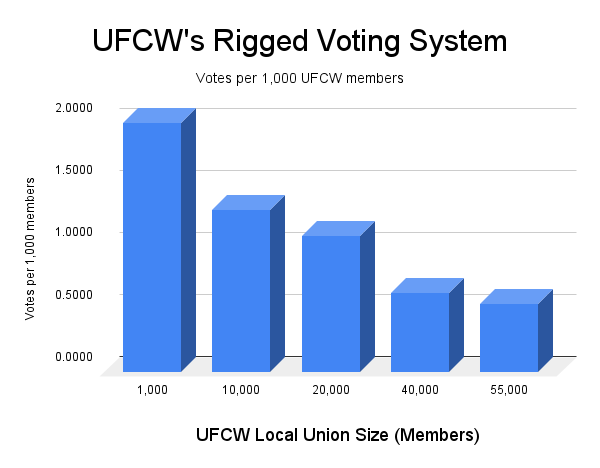
The lawsuit does not ask the court to instate 1 Member 1 Vote (1M1V), but to merely give UFCW members the opportunity to make their own decisions. An alternative to direct voting is a flat vote multiplier, which would give every local the same number of voting delegates per members.

Frequently Asked Questions
-
UFCW rank & file members, Iris Scott of UFCW 1459 in Massachusetts, and Kyong Barry of UFCW in 3000 in Washington state, are the plaintiffs. Kyong has worked in grocery, including Albertsons, or 20 years and served on the board of her union and is President of EW4D board. Iris works at a grocery co-op.
Attorneys Thomas H. Geoghegan and Will Bloom of the firm Despres, Schwartz, & Geoghegan, LTD. are filing the suit on behalf of the plaintiffs. Tom Geoghegan and Will Bloom have long histories in representing rank and file members from many unions also seeking to enforce union democracy principles and practices pursuant to Federal law.
This lawsuit is funded by the Essential Workers for Democracy, though should the plaintiffs prevail, it is likely that they will recover attorneys’ fees for the lawsuit preparation and filing.
-
The lawsuit is a Federal suit challenging several aspects of the UFCW process for allocating delegates and voting power for the UFCW Constitutional Convention where members of the UFCW have the opportunity to govern their union.
It is the highest governing body for UFCW members. The UFCW Constitutional Convention occurs every five years, the most recent occurring in 2023.
One specific challenge is to the apportionment of delegates (and Convention votes ) to local unions by a formula based on the number of members in each local union. The process was established decades ago when the disparity between small and large local unions was not as great as today.
The undemocratic effect of the current practice is that some members have 300 times more voting power than other members.
The Federal law that governs labor unions in their governance procedures is the Labor Management Reporting and Disclosure Act (LMRDA), and a core principle and point of law is that every union member is entitled to an equal right to vote.
This lawsuit challenges the current UFCW Constitutional procedure as being in direct violation of the LMRDA.
Also, a separate UFCW Constitutional provision awards local union top officers automatic convention delegate (and voting) status depriving rank and file members from challenging them in a separate delegate election process, again in direct violation of the LMRDA.
Should the plaintiffs win a favorable legal resolution to this suit, it will affect many other national unions that have similar convention delegate selection processes.
-
While this lawsuit is an attempt to correct the undemocratic nature of the current UFCW delegate selection process to the constitutional Convention where top officers are elected, there is growing demand among union members to transform the election of their top officers to a One Member One Vote 1M1V process. Over 20 American unions have this process now, the most recent and well-known adoptions of One Member One Vote having been in the Teamsters Union and the United Auto Workers Union.
Both of these unions have undergone transformations to more membership control of governance due in part to the change to 1M1V for election of top officers.
This lawsuit, should it be successful, would provide for more rank and file control of the union’s governance process at the Convention. This would include the election of the union officers. However, it is the belief of the plaintiffs and Essential Workers for Democracy that the most fair and democratic process for electing top officers is the adoption of 1M1V. Coupled with a Convention delegate allocation process that provides a fair and representative base of delegates for the consideration, debate and voting on constitutional amendments and resolutions, these two revitalizations of the UFCW would go a long way to restoring the rank and file to governing their own union.
-
On May 21, 2026, Judge Trevor N. McFadden of the United States District Court for the D.C. District made a ruling in the case. The full language of the opinion is available here.
Judge McFadden ruled that the UFCW’s delegate apportionment system does not violate the LMRDA’s equal right to vote for union members. Judge McFadden rests his opinion on the basis of two main arguments. First, Judge McFadden argues that so long as members have an equal right to vote within their local unions, even if that right is afforded unequally to members of different locals, the union is not in violation of the LMRDA. The opinion, in support of arguments made by the UFCW International, further claims that “The key here is that rank-and-file UFCW members have no voting rights at all.”
Judge McFadden’s opinion goes on to state that because the UFCW International Constitution never claims to give voting rights to individual UFCW members, only to elected Convention delegates, that, “Under this arrangement, then, no UFCW member has a right to vote at the convention….Because that denial applies across the board, all UFCW members have equal rights.”
The plaintiffs are not taking this Judge’s flawed decision lying down. The case will go to the D.C. Court of Appeals, where a panel of three judges will make a final ruling on the case, likely within the next twelve to eighteen months. Union democracy cases have been won at the Court of Appeals in the past, and we remain hopeful that we can produce stronger union democracy laws for union reformers across the labor movement.
Read more on the decision to appeal here.