
In Defiant Move, Rank-and-File Plaintiffs Appeal Lawsuit Against UFCW International
UFCW International leads court to say: “Rank-and-file UFCW members have no voting rights at all.”
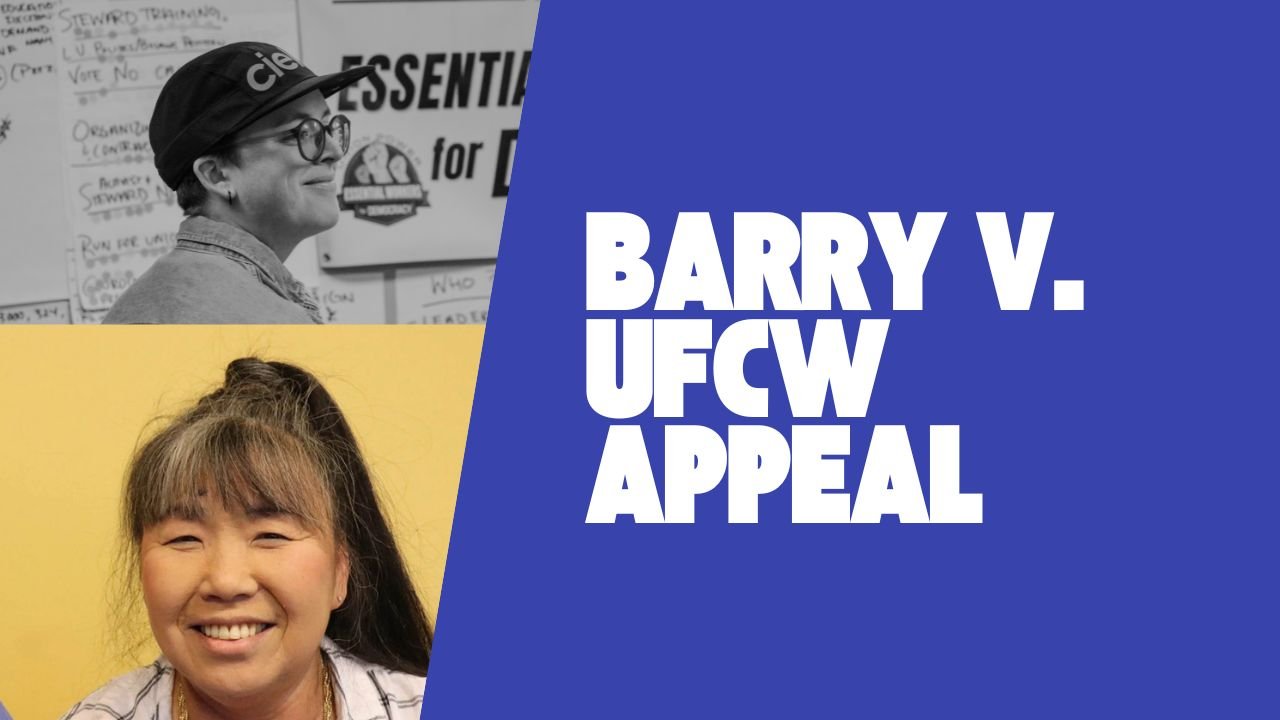
Rank-and-file UFCW member plaintiffs Iris Scott and Kyong Barry.
Rank-and-file UFCW members Kyong Barry and Iris Scott are filing an appeal against a decision made by the D.C. District Court in Barry v. UFCW International, the lawsuit filed in 2024 alleging that the UFCW International’s convention delegate apportionment system is in violation of the LMRDA.
On May 21, 2026, Judge Trevor N. McFadden of the United States District Court for the D.C. District made a ruling in the case. The full language of the opinion is available here.
Judge McFadden ruled that the UFCW’s delegate apportionment system does not violate the LMRDA’s equal right to vote for union members. Judge McFadden rests his opinion on the basis of two main arguments. First, Judge McFadden argues that so long as members have an equal right to vote within their local unions, even if that right is afforded unequally to members of different locals, the union is not in violation of the LMRDA. The opinion, in support of arguments made by the UFCW International, further claims that “The key here is that rank-and-file UFCW members have no voting rights at all.”
Judge McFadden’s opinion goes on to state that because the UFCW International Constitution never claims to give voting rights to individual UFCW members, only to elected Convention delegates, that, “Under this arrangement, then, no UFCW member has a right to vote at the convention….Because that denial applies across the board, all UFCW members have equal rights.”
“No UFCW member has a right to vote at the convention….Because that denial applies across the board, all UFCW members have equal rights.”
You read that right. The UFCW International has successfully persuaded a judge that no UFCW members have the right to vote at the highest decision-making body of the union.
Second, Judge McFadden upholds the UFCW International’s argument that a more proportionate delegate system would be too costly to the UFCW.
Delegates to the 2023 UFCW International Convention rejected a proposal to limit officer salaries to $250,000. All in all, the UFCW spends over $20 million each year on the salaries of just over 60 union officials each making more than $250,000. Yet, the UFCW International argued that union democracy and a voice for rank-and-file members of the union is too extravagant an expense.
To add insult to injury, the UFCW International has filed for costs against Kyong Barry and Iris Scott. The UFCW International holds over $600 million in assets from membership dues. On top of their commitment to deny members the right to vote, the UFCW International is attempting to extract money from two rank and file grocery workers.
On the decision to appeal, Kyong Barry, a front-end manager at Safeway in Seattle, Washington who has spent many years as a grocery worker and union activist, said, “That’s the core of a union, to fight for the members. For the International to say, ‘We don’t care about that,’ and to only care about themselves, it needs to stop. We have to keep fighting.”
The plaintiffs are not taking this Judge’s flawed decision lying down. The case will go to the D.C. Court of Appeals, where a panel of three judges will make a final ruling on the case, likely within the next twelve to eighteen months. Union democracy cases have been won at the Court of Appeals in the past, and we remain hopeful that we can produce stronger union democracy laws for union reformers across the labor movement.
We know that we can’t fully rely on the courts to simply hand over justice to working people, whether that’s in our workplaces or in our own unions. Legal wins for working people have been hard-fought through decades of deep organizing on the shop floor with our coworkers. While the law can at times help support organizing in our workplaces and in our unions, there are no shortcuts.
We are proud of Kyong and Iris, and we admire their courage to take on the power structure of the UFCW bureaucracy.
While Barry v. UFCW International progresses to the D.C. Court of Appeals, Essential Workers for Democracy will continue to organize, educate, and unite rank-and-file union members to fight for better working conditions, stronger contracts, and a more democratic union.