Sooper Strike Bulletin #5 - Sat., Feb. 15th 2025
What’s causing high grocery prices?
It’s no secret: grocery prices are up. The CEOs and corporate giants are hoping that community members blame high prices on “excessive” worker demands for fair pay, healthcare, and pensions. The real culprit is their failed multi-billion dollar merger, corporate greed, and price gouging.
FAILED MERGER
In 2022, Kroger and Albertsons announced their proposed $25 billion merger. A coalition of UFCW Locals 7, 324, 770, 1564, and 3000, along with Teamsters Local 38 and anti-trust regulators, successfully blocked the merger last December.
The merger would have consolidated two of the largest grocery chains in the US. Together, Kroger and Albertsons hold the second biggest share of the industry at 11%. Over 5,000 stores across the country would have been impacted by the merger.
Kroger spent approximately $800 million on the failed merger campaign. Now, Albertsons is suing Kroger for $1 billion, including $600 million for “lost shareholder value.”
After the merger collapsed, Kroger issued a $7.5 billion stock buyback plan, lining investors' pockets rather than making good on their promises to lower prices and pay workers a fair wage. Rather than investing back in stores, workers, and communities, Kroger prioritized its billionaire stockholders.
Worker organizing defeated what would have been one of the largest corporate mergers in US history, avoiding layoffs and price increases for customers.
INFLATION OR CORPORATE GREED?
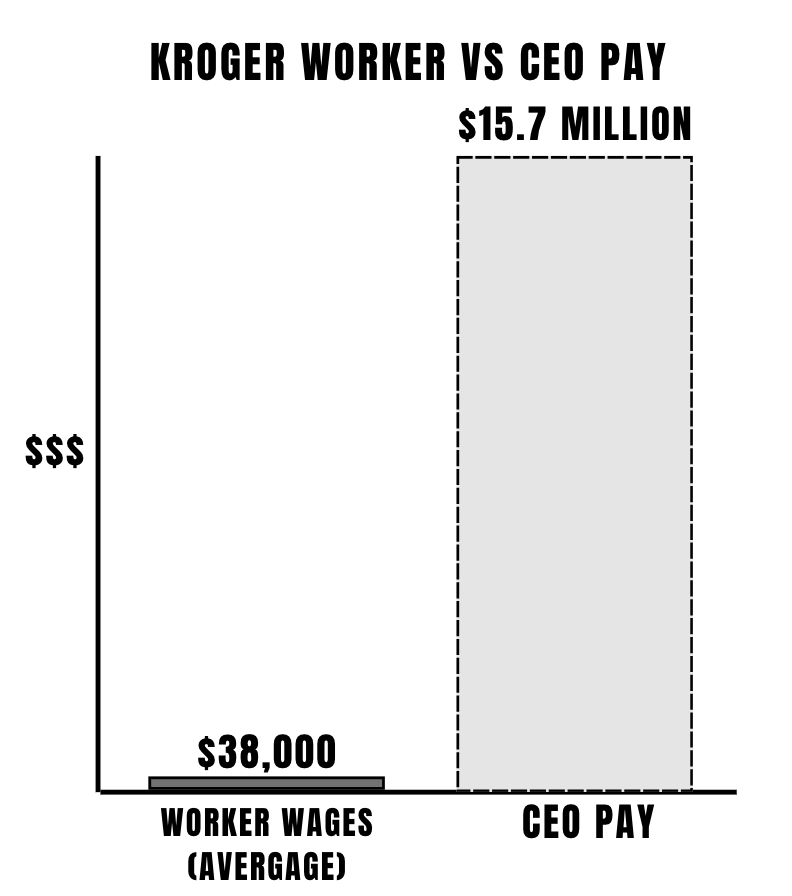
As grocery prices continue to rise – up 25% from 2020 to 2024 – grocery companies like Kroger blame inflation and increased supply-chain costs. But with Kroger’s $7.5 billion stock buy back, $2.8 billion reported profits last year, and $15.7 million CEO salary (502x the median Kroger worker!), is inflation really to blame?
In August, Kroger's Senior Director for Pricing Andy Groff admitted in court that the store had raised prices of certain items including eggs and milk beyond inflation. He said the company’s practice is to "pass through our inflation to consumers,” all while retaining substantial profit margins and high corporate pay.
Kroger is eager to pass increased costs on to customers and share its record profits with billionaire investors. But why not with its workers? As prices and profits go up, shouldn’t wages?
King Soopers’ so-called “Last Best and Final Offer” included multi-tier wage discrimination, with some workers receiving no increase at all and thousands more getting a $0.25 initial raise.
Workers know that the company can offer more. Members of UFCW Local 7 are fighting for living wages and fair staffing without cuts to pensions.
Hear from Kay, a Starbucks barista on strike at King Soopers in Commerce City, about the failed merger, Kroger’s priorities, and why customers and workers are on the same side:
“$7.5 billion stock buybacks for shareholders....Why isn’t the community seeing better results? Why aren’t we putting that money back into stores?
[Kroger] has become comfortable with the idea that they’ll be able to scapegoat us, as the employees. But it’s not going to us. I’m not getting paid more, I’m not getting better benefits...I’m not getting overtime — if anything, they’re taking overtime from us.
It’s 100% profit and greed.”