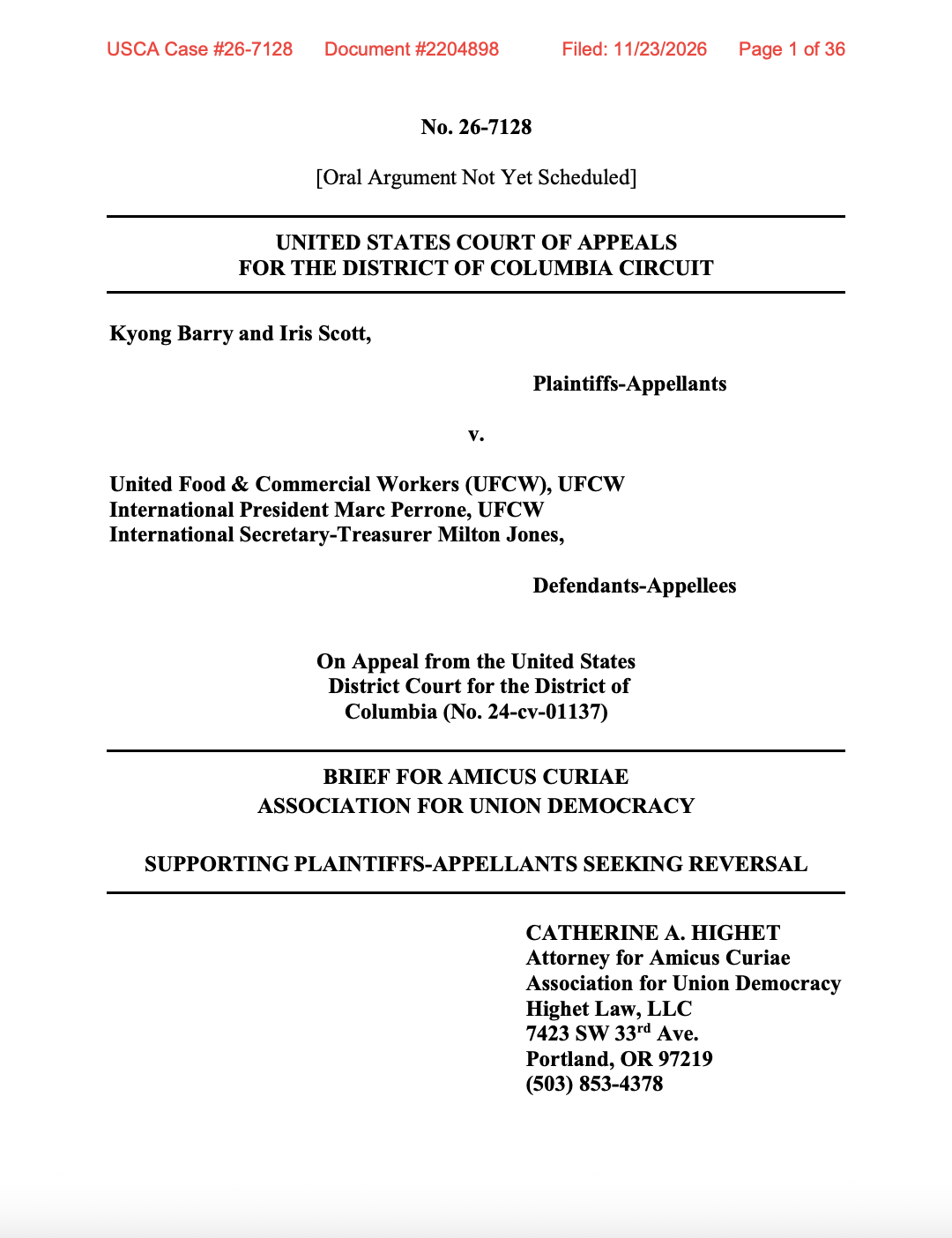
The Association for Union Democracy (AUD) has filed an amicus brief with the U.S. Court of Appeals in Barry v. UFCW International, the lawsuit brought by rank-and-file members claiming that the UFCW’s current convention delegate apportionment system violates federal labor law. Read the brief below.
An amicus curiae brief is a legal document filed by a non-party to offer additional information and expertise in a case. AUD is a non-profit organization dedicated to defending the democratic legal rights of union members and weeding out corruption. AUD has supported organizations including Miners for Democracy and Teamsters for a Democratic Union.
In May 2026, Judge Trevor N. McFadden of the United States District Court for the D.C. District made a ruling in the case that the UFCW’s delegate apportionment system does not violate the equal right to vote under the Labor-Management Reporting and Disclosure Act (LMRDA). Plaintiffs Kyong Barry and Iris Scott, both rank and file union members of UFCW Locals 3000 and 1459 respectively, decided to appeal the decision.
In Judge McFadden’s initial decision, he writes that because the UFCW International Constitution never claims to give voting rights to individual UFCW members, only to elected Convention delegates, that, “Under this arrangement, then, no UFCW member has a right to vote at the convention….Because that denial applies across the board, all UFCW members have equal rights.”
The amicus brief from AUD challenges this notion, writing that “Members of an International union have equal rights within the International.”
Further, the amicus brief encourages the court to intervene in the imbalanced delegate apportionment system, which affords significantly higher voting power to delegates representing smaller locals than larger ones. “AUD emphatically supports the principle of democratic union self-governance that presumably motivated the District Court’s hesitance to act here,” they write. “It is the ‘primary purpose’ of the LMRDA. Finnegan v. Leu, 456 U.S. 431, 435-36 (1982); Hotel Employees, 391 U.S. at 496-97. But that principle weighs in favor of, not against, enforcing core democratic rights.”
Click here to read the brief, or view it in the PDF viewer below.