Workday: ‘How 9,000 Grocery Workers Are Banding Together in Minnesota’
Originally published in Workday Magazine
By Sarah Lazare
Workers are in coordinated bargaining, and demanding better staffing, secure retirement, and good healthcare.
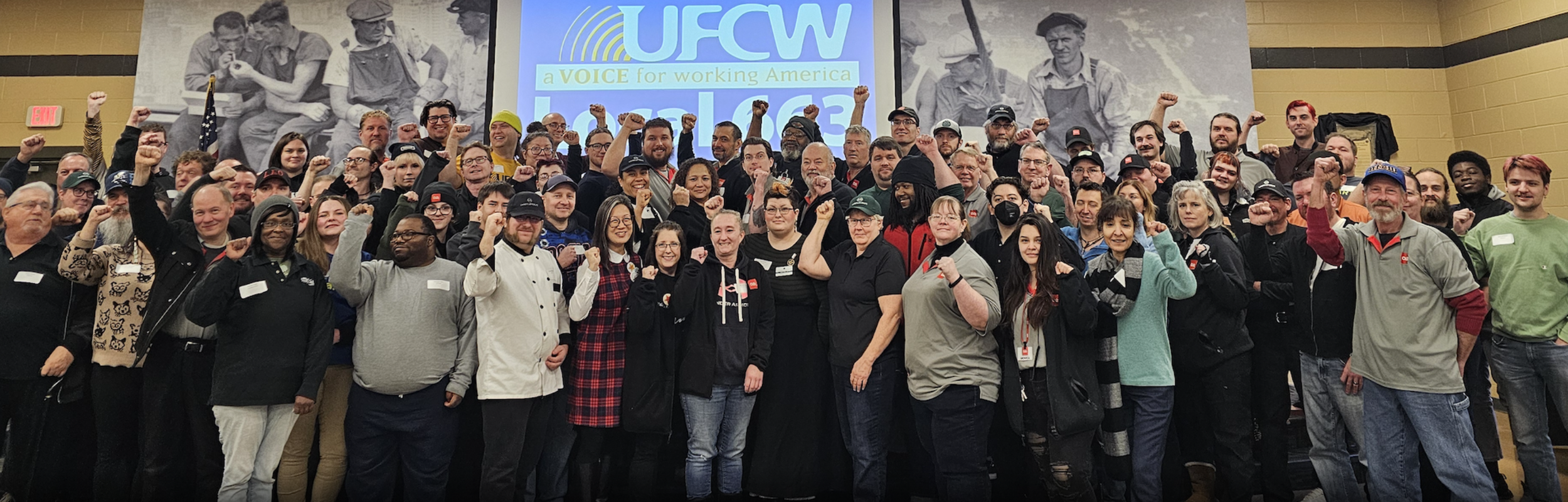
2025 UFCW Local 663 Bargaining Committee, via UFCW Local 663
Monica Duque never knows how many hours she is going to get in a given week. She works at the Jerry’s Cub Foods on East Lake Street at the front of the store, helping customers, overseeing cashiering, and running online shopping. She finds out her hours, she explains, “when the schedule is posted on Friday, for the week after next.”
“There is no consistency,” says the 24 year old, which makes it hard to save money, or plan much for the future. She makes a little over $20 an hour, and even being cut 10 hours in a week can have a big impact on her finances. “I can do morning one day then night shift the next day. I go from eight-hour days to barely getting seven-hour days. I can never really rely on how much money I’m going to make.”
“People just want to be able to afford to live. One job should be enough to do that.”
Duque is one of around 9,000 Minnesota grocery workers whose union contracts with 14 different companies expired in early March. Of these workers, the vast majority are engaged in coordinated bargaining with seven employers: Haug’s Cub Foods, Jerry’s Cub Foods/Jerry’s Foods, Kowalski’s Markets, Radermacher’s Cub Foods, Lunds & Byerlys, Knowlan’s Festival Foods, and UNFI Cub Foods.
At least the bargaining is coordinated on the part of their union, United Food and Commercial Workers Union (UFCW) Local 663. The union sits down at the table with the employers together, and gives them joint proposals, but the employers are insisting on bargaining seven different agreements.
“The employer does not want to do coordinated bargaining. They think it’s better to do it all separately,” UFCW 663 President Rena Wong told me over Zoom after one such bargaining session on February 25 at the Minneapolis Federation of Teachers building. Behind her sat 65 members of the bargaining committee, listening to our interview.
Wong explained that workers, nonetheless, are hoping to band together to rectify the poor pay and that workers like Duque are facing. “Both the hourly wage and the guaranteed number of hours that we actually get scheduled are both tied and dependent on each other for us to be able to make enough to take care of ourselves and our families,” she said.
There are signs that the skeleton crews are also souring the shopping experience for customers. UFCW Local 663 ran an online survey of more than 500 customers of Minnesota Cub Foods, owned by United Natural Foods Incorporated (UNFI), from January 27 to March 3. They found that customers want to see more staffing in stores, with 84% saying they’ve noticed “negative” changes to staffing. According to the union, concerns about staffing ranked even more highly than worries about food prices.
“Over the last 12 months, UNFI has severely cut labor hours in stores, and implemented radical changes to the scheduling of its employees,” the union said in a statement accompanying the survey findings.
According to Wong, there are a number of other priorities workers are fighting for. They don’t want the company to have the power to transfer workers to other stores whenever they want, they want secure retirement, and they want improvements to their health coverage (all of the eligible workers who are part of coordinated bargaining are on the same health fund). “Folks want more of their dental covered,” Wong says. “They want a little bit more of their vision covered. They want their out-of-pocket max and deductible to go down a little bit.”