In These Times: ‘Grocery Workers VS Goliath’
Originally published in In These Times
by Sarah Lazare
Kroger and Albertsons tried to merge; union organizing stopped them. But the fight for grocery workers is just beginning.
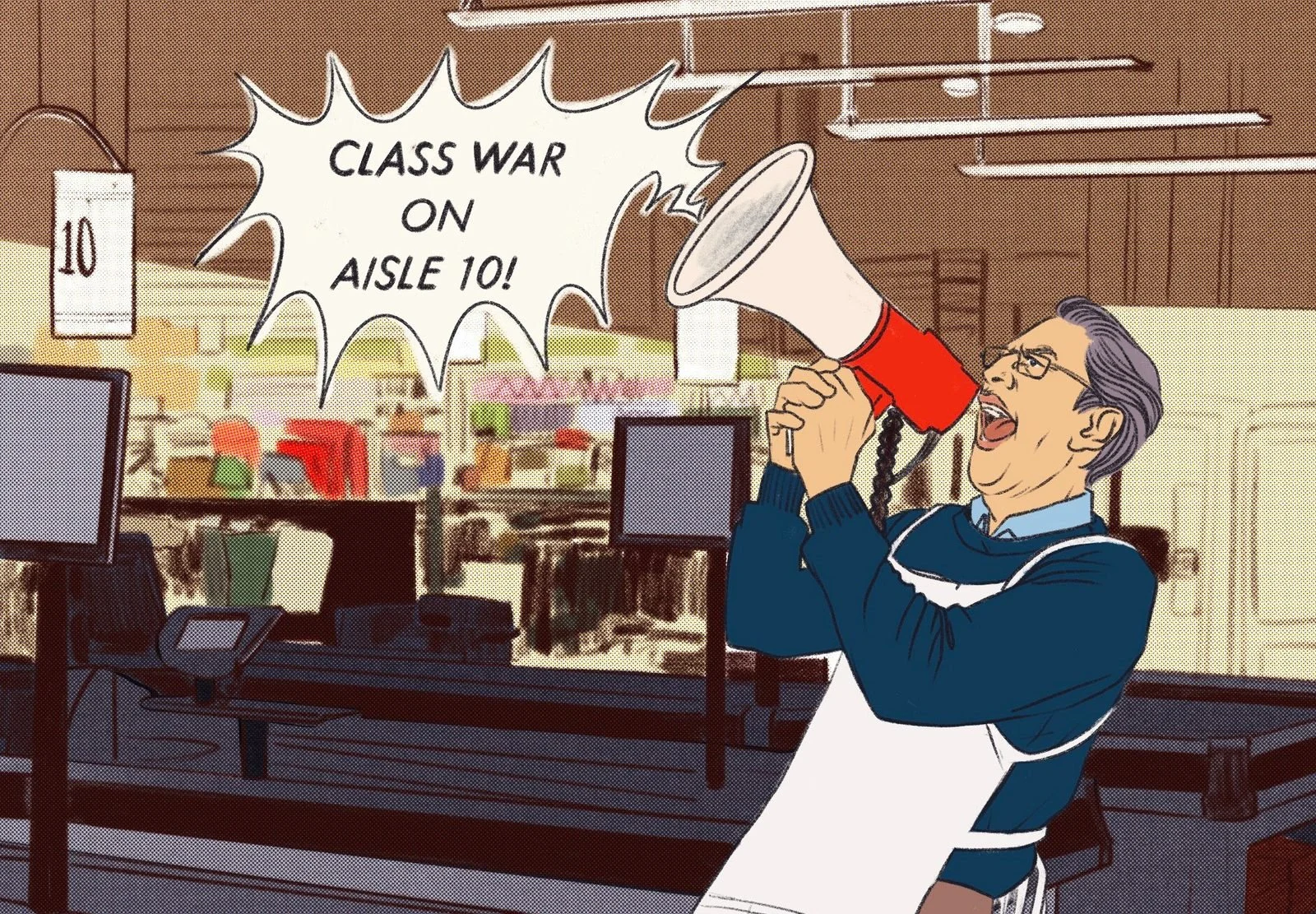
Illustration for In These Times by Rachelle Baker
In early February, when temperatures in Denver plunged to seven degrees below zero and snow dusted the sidewalks, Martin Bonilla, bundled in two jackets and a neck warmer, walked a picket line 1,000 miles from his home of Fillmore, Calif. Bonilla works in the produce department at Vons and had flown to Colorado in the early morning after finishing an 11-and-a-half-hour shift.
Over the next eight days, Bonilla picketed five of the 77 striking Kroger-owned King Soopers stores in Colorado, in support of 10,000 members of United Food and Commercial Workers (UFCW) Local 7, putting in 16-hour shifts each day before going back to his hotel, exhausted. On the lines, he wore new boots he had bought the night before his flight and shoved hand warmers into his gloves to protect from a cold that was so piercing he went hours without texting or calling his wife, not wanting to remove his hand from his glove.
The main thing that stuck out to Bonilla, who is 53, were workers far older than he is, pushing walkers. He has worked in grocery stores for 30 years and says, “It hurt me to see people like that. They’re probably gonna be working until they die.”
“I asked them, ‘How come you’re here? You look like you’re ready to retire,’ ” Bonilla says. They told him: “We can’t afford it.”
Bonilla traveled to Denver because he is on one side of an intensifying battle — of union locals within the UFCW against these grocery behemoths that set standards across the industry.
Bonilla believes his fate as a lifelong grocery worker will be defined by the outcome. He is probably right.
UFCW locals that led a successful, multiyear fight to block an attempted merger between Kroger and Albertsons, concerned it would result in greater exploitation of grocery workers and customers. It would have been the biggest supermarket merger in American history, worth $25 billion, and its failure likely played a role in the recent resignations of the CEOs of both companies.
Now, four out of six of the UFCW locals that helped take down the merger Locals 7, 770, 324 and 3000 — are facing their own contract expirations in 2025, a year that will see a total of 130,000 UFCW grocery workers with contract expirations — 70,000 of them Kroger or Albertsons workers from those four locals. They are up against employers who, they say, are furious with them for disrupting their corporate plans. Local 7’s strike has been called off for now — its contract extended 100 days — which means it is in negotiations even as some of these other locals could go on strike.
As these locals gear up, their muscle memory of working together to defeat the merger is coming in handy. Leaders and workers told me that, to gain ground against such big companies, they are showing unity across geographical distances and across companies, holding exchanges among members, sharing skills and suggestions, and showing up for each other’s fights. When they come together, workers discover they face similar issues, particularly chronic under-staffing, which leads to long lines and an exhausting pace.
Workers at both companies are fighting together and trying to unite the unionized workforces of both grocery giants. Bonilla traveled all the way to Denver to walk picket lines even though he doesn’t work for Kroger. His employer, Vons, is owned by Albertsons, the other behemoth. “That was not a pleasant time … because of the weather, but I’ll go again if they need me to,” he says, “because we have to stay together. Workers, we need this.”
“These companies are huge and operate at a huge scale,” Boyke says. “To fight against them, we have to do the same.”
When Dylan Boyke drives to his 3:30 A.M. shift in the bakery of an Albertsons in Westminster, Calif., the city is quiet and the streets are empty. Only a few other workers are in the building when he shows up, usually night stockers and janitors, but those hushed hours are his most hectic, a race to get everything ready before the store opens at 6 a.m.
It’s his job to prepare “pretty much everything” for the day, he says, so the mid-shift can put it on the floor: the bagels, donuts, rolls, cookies and muffins for the display, the cinnamon rolls, pastries and turnovers for the sales floor.
The work is intense and nonstop, he explains, especially since his employer has been rolling back staffing levels, a complaint I heard from every grocery store worker interviewed for this article. “When I started in 2018, we had probably at least four people every day in the department working eight hours,” Boyke says, “but now, we’ll have three, or maybe have someone working multiple departments and they’ll help for a few hours.”
When Albertsons and Kroger announced plans for the merger in 2022, Boyke was part of an increasing wave of opposition. He was worried, he says, that staffing problems would get worse because “we would have less leverage” if the merger went through. His local, 324, joined with Locals 7, 400, 770, 1564 and 3000 to form the Stop the Merger coalition. About 100 community and worker organizations joined the effort, including Teamsters Local 38.
“We were the face of the opposition” to the merger, says Kim Cordova, president of UFCW Local 7. Cordova started as a grocery bagger for Safeway in high school and stayed for eight years before becoming staff for Local 7. She returned to Safeway in 2009, where she ran for president of the local UFCW on a reform platform to make UFCW, as she put it, “a more member-centered union.”
Under internal pressure, the international union eventually came out against the merger in May 2023. Cordova appears to take pride in the fact that the coalition moved swiftly to oppose the merger and did not hesitate to play a leadership role. When asked about the role the international union played, Cordova says: “We didn’t wait for the cavalry to comesave us. We were the cavalry.”
Some officials took notice. The Federal Trade Commission (FTC) and attorneys general from eight states launched lawsuits to prevent the merger, as did Colorado and Washington. Workers testified in these cases, held webinars and press conferences, staged workplace actions and even talked with customers.
Monique Hightower was one of the workers who spoke at an FTC listening session on November 1, 2023, and she warned of the disastrous consequences of the 2015 merger of Albertsons and Safeway. During that merger, Albertsons sold redundant stores to Haggen, but Haggen expanded too quickly and went bankrupt, and eventually was sold to Albertsons. Hightower was working at the time for an Albertsons store that was sold to Haggen and then abruptly closed. “I was without a job for a whole year,” she testified at the session. “It was a very uncertain and stressful time for me. I couldn’t afford to pay my rent, so I had to move in with my mother. Not many workers had that option, and some ended up losing their housing and becoming homeless.”
She did odd jobs to survive, before eventually landing work as a deli clerk at an Albertsons in South Los Angeles, Calif. “I don’t want any worker to struggle as my coworkers and I did back then,” she testified.
The Stop the Merger coalition warned that a monopoly formed by Kroger and Albertsons — the second- and fourth biggest grocers in the country would not only drive down working conditions but hike prices. The FTC echoed the argument; unions benefit from the fact they are “separate and competing companies,” so if the companies combined (and stopped trying to poach workers from each other), UFCW and other unions would lose critical leverage.
One of the companies’ main arguments was that a merger was necessary to compete with Amazon and Walmart. But during the FTC hearings, Roundy’s Division President Michael Marx (working under the Kroger umbrella) confirmed that Mariano’s (also owned by Kroger) maintained high prices on eggs even after Walmart and Meijer lowered them, and only reduced the prices when Albertsons’ Jewel Osco did so. In other words, it was Albertsons, and not Walmart or Meijer, that created competitive pressure to drive down prices in this instance.
Late in 2024, Judge Adrienne Nelson of the Oregon District Court blocked the merger, as did a Washington state court judge, simultaneously. The Stop the Merger coalition praised the “well-reasoned decisions” and said the development would be good for workers and shoppers who deserve “better choices and lower prices.”
Kroger and Albertsons, along with Costco and Walmart, account for two-thirds of all grocery sales in United States. This consolidation trend aligns with one that extends beyond grocery: One 2018 study found that, in the past 20 years, three out of four U.S. industries have seen an increase in corporate consolidation.
Boyke is a member of UFCW Local 324’s bargaining committee and part of Essential Workers for Democracy (EWD), a rank-and-file movement within UFCW fighting for “union democracy,” “strike readiness” and “coordinated bargaining.” EWD argues that all workers stand to benefit from more coordination and solidarity across locals, and they would like to see master agreements with the grocery giants, similar to the ones the United Auto Workers have with the Big Three automakers or the Teamsters with UPS.
“These companies are huge and operate at a huge scale,” Boyke says. “To fight against them, we have to do the same.”