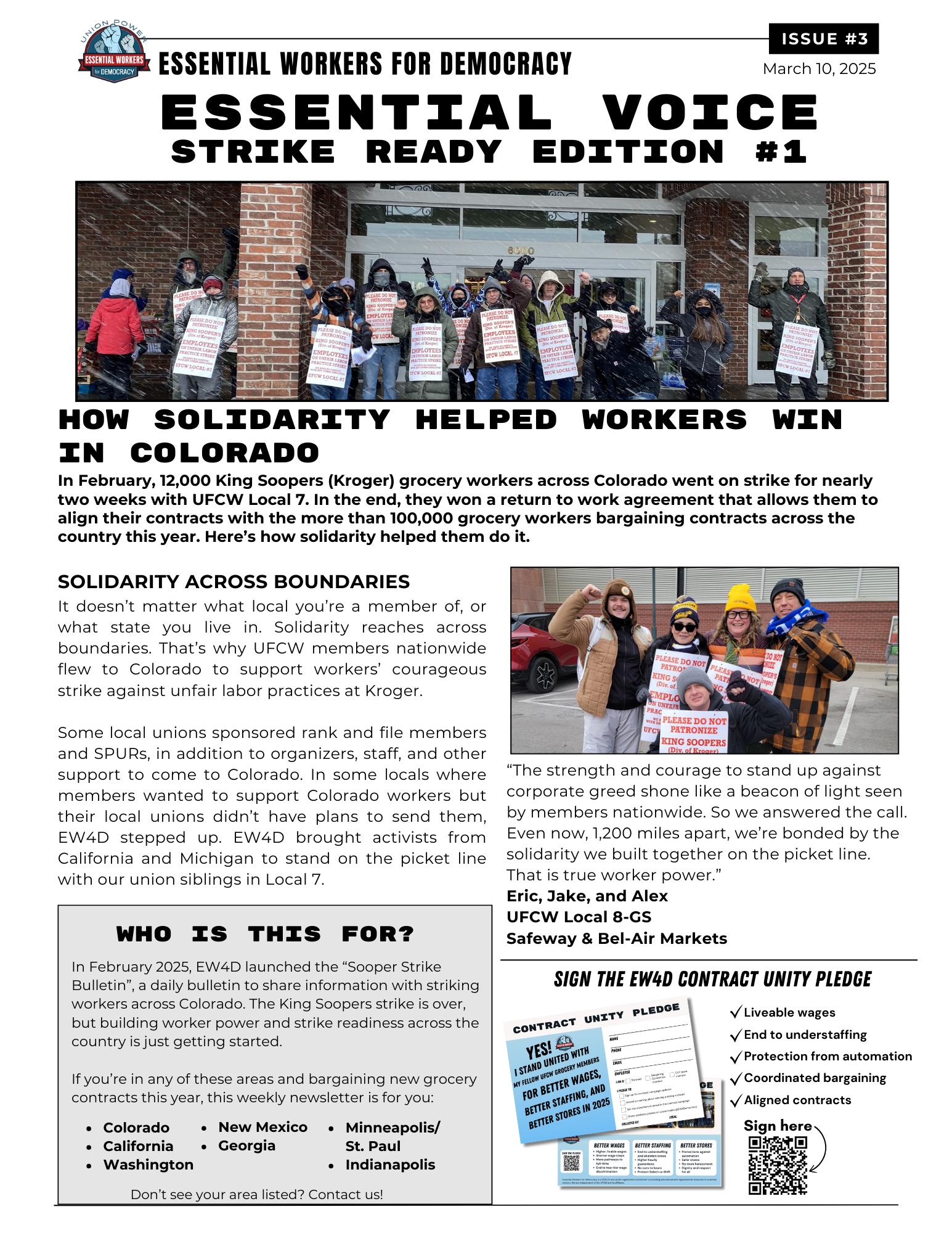
How Solidarity Helped Workers Win in Colorado: Essential Voice Strike Ready Edition #1
In February, 12,000 King Soopers (Kroger) grocery workers across Colorado went on strike for nearly two weeks with UFCW Local 7. In the end, they won a return to work agreement that allows them to align their contracts with the more than 100,000 grocery workers bargaining contracts across the country this year. Here’s how solidarity helped them do it.

SOLIDARITY ACROSS BOUNDARIES
It doesn’t matter what local you’re a member of, or what state you live in. Solidarity reaches across boundaries. That’s why UFCW members nationwide flew to Colorado to support workers’ courageous strike against unfair labor practices at Kroger.
Some local unions sponsored rank and file members and SPURs, in addition to organizers, staff, and other support to come to Colorado. In some locals where members wanted to support Colorado workers but their local unions didn’t have plans to send them, EW4D stepped up. EW4D brought activists from California and Michigan to stand on the picket line with our union siblings in Local 7.
“The strength and courage to stand up against corporate greed shone like a beacon of light seen by members nationwide. So we answered the call. Even now, 1,200 miles apart, we’re bonded by the solidarity we built together on the picket line. That is true worker power.”
Eric, Jake, and Alex
UFCW Local 8-GS
Safeway & Bel-Air Markets
WHO IS THIS FOR?
In February 2025, EW4D launched the “Sooper Strike Bulletin”, a daily bulletin to share information with striking workers across Colorado. The King Soopers strike is over, but building worker power and strike readiness across the country is just getting started.
If you’re in any of these areas and bargaining new grocery contracts this year, this weekly newsletter is for you:
Colorado
California
Washington
New Mexico
Georgia
Indianapolis
Minneapolis/St.Paul
Don’t see your area listed? Contact us!

What is Coordinated Bargaining?
Contract alignment is also known as coordinated bargaining — or as we like to call it, bargaining big. Coordinated bargaining increases workers’ power to win by getting rank and file members across different locals, or even across different unions, to take action together.
It’s how other union members have won big. When 340,000 UPS Teamsters fought for their national contract in 2023, they leveraged the largest strike threat against a single employer in US history, and it paid off big time. When 150,000 UAW members struck the Big Three automakers that same year, they ended two-tier and won up to 88% wage increases.
When we bargain big, we win big. UFCW grocery workers are next up, and this contract alignment has allowed Colorado workers to lead the charge for better staffing, better wages, and better stores.
The Big Grocers know about strength in numbers. That’s why they spent nearly a billion dollars on the failed Kroger and Albertsons merger — and why Kroger and Albertsons illegally collaborated during contract bargaining in 2022.
We saw how much the Big Grocers don’t want coordinated bargaining. In fact, Kroger was so scared, they filed a completely farcical lawsuit attempting to shut down coordinated bargaining. It won’t work.
Solidarity isn’t against the law. In their fight against unfair labor practices, Colorado workers advanced the fight for over 130,000 other grocery workers across the country, too. In their heroic strike, members of UFCW Local 7 showed the company what worker power truly looks like. Colorado workers won for themselves, and they won for over 100,000 other workers nationwide. Strikes and solidarity work.
Kroger & Albertsons CEOs Both Step Down
On March 3, 2025, CEOs of both Kroger and Albertsons abruptly stepped down. Kroger CEO Rodney McMullen suddenly resigned after an investigation into his personal conduct found he violated the company’s ethics policy, while Albertsons CEO Vivek Sankaran announced his retirement.
McMullin and Sankaran led Kroger and Albertsons into a failed merger that wasted billions of dollars instead of listening to workers and investing in stores.
Kroger's CEO resisted raising worker wages while making 500 times the average Kroger employee. Now that these CEOs are gone, Kroger and Albertsons can choose to continue prioritizing executive wealth or finally invest in the workers who make our grocery stores run.
No matter who's in charge, we're building the power to win what we deserve: better wages, better staffing, and better stores. The workers who defeated their monopoly merger are bargaining new contracts this year — and we're ready to fight like hell to win!